
 News
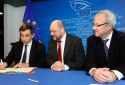 Henri Malosse, EESC president, Martin Schulz, European Parliament president, and Ramon Luis Valcárcel Siso, Committee of the Regions president, have just signed an historic agreement between the three institutions. Faced with a growing disconnect between EU institutions and the public, the three presidents have responded with the creation of a genuine "citizens' pillar" for the people of Europe.
While the Treaty of Rome founded the EESC alongside the European Parliament, developments over time have meant that MEPs now play a key role in the EU's legislative process, while the EESC has retained a purely consultative role, similar to that of the Committee of the Regions. Yet by depriving itself of a pillar - and a bridge - connecting it to the people of Europe, the EU has seen the gap between it and the public grow ever wider, something which risks jeopardising the entire European project.
Conscious of this situation and mindful of their responsibilities here, the presidents of the three institutions have formulated their own response: to bolster the democratic foundations of the EU.
The EESC has opted to move closer to the European Parliament and to consolidate its relations with the Committee of the Regions. While the Commission has widened its range of information resources in recent years, the European Parliament finds itself subject to ever-increasing pressure from private lobbies. This has revealed a need to rely more on the EESC and the CoR, helping to strengthen its democratic legitimacy.
All the elements needed to carry out this "institutional step" have come together in recent months: an increased sense of public awareness, a shared political will and a favourable political climate ahead of the future European elections, highlighting the importance of the link between the EU institutions and the public. The three institutions have successfully risen to this challenge.
Coming together - a win-win situation
After having shared their ideas and identified how they can optimise their activities and coordination, the EESC, CoR and European Parliament have embarked on a fundamental agreement.
For the EESC, this agreement:
Gives the representatives of organised civil society a stronger voice at the European Parliament, thereby reinforcing the EU's democratic pillar in relation to the European Commission and the Council;
Ensures that legislative action is more effective by making the EESC's work more visible and by ensuring its members' views are heard more clearly in the legislative process, making the best possible use of available resources;
Consolidates the EESC's role in the legislative process.
Anticipation, coordination and optimisation are the watchwords of this tripartite agreement, which comes into immediate effect once signed.
The new elements introduced by the text include incorporation of the EESC's impact assessments into the European Parliament's legislative revision work and provision for the Parliament to consult the EESC's opinion on any matter which it deems to be of importance. In an age where access to quality information provides serious leverage to enhance action taken, and where the public expects European budgets to be soundly managed, the EESC is joining forces with the European Parliament and the CoR to set up a Joint Documentation Centre that will be able to rise to the challenges that lie ahead.
Henri Malosse, Martin Schulz and Ramon Luis Valcárcel Siso sign the tripartite agreement, 05/02/2014 in Strasbourg. Photo credit: © European Union 2014.
